
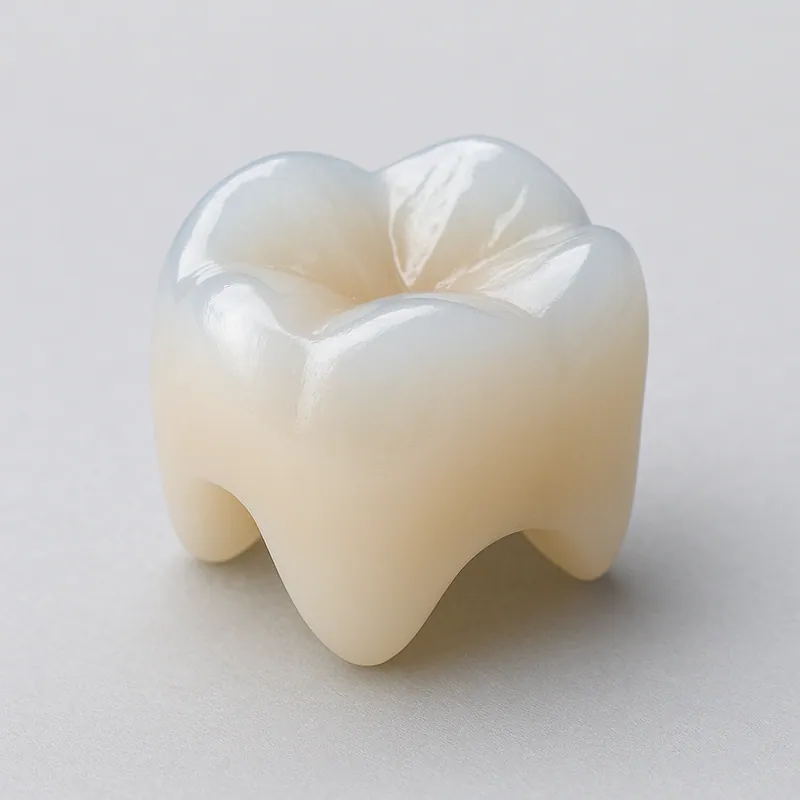
Zirconia and e.max are the two materials we fabricate most often, and the question we hear most on the phone is which one a case should get. There is rarely a single right answer, but there is usually a better one. Here is how we think about it at the bench.
The short version
- Zirconia when strength, longevity and limited clearance lead the decision, especially for molars, bridges and patients who are hard on their teeth.
- E.max when esthetics lead, especially in the smile line next to natural teeth, and when you plan to bond the restoration.
Everything else is a matter of weighing those two priorities for the patient in front of you.
Where zirconia earns its place
Zirconia is the stronger of the two by a wide margin, which is why it has become the default for posterior work. It handles heavy occlusion well, tolerates thinner sections than glass ceramics, and is the usual choice for multi-unit bridges.
Consider zirconia when you see:
- Second molars and posterior bridges
- Bruxism, wear facets or a history of fractured restorations
- Limited occlusal clearance where you cannot reduce further
- Implant-supported crowns, where strength and screw access matter
Modern translucent zirconia looks far better than the opaque frameworks of a decade ago. For most posterior cases, a well-characterized monolithic zirconia crown is hard to tell apart from its neighbors at conversational distance.
Where e.max earns its place
Lithium disilicate handles light more like natural enamel. That translucency is the reason it remains the go-to for anterior crowns and veneers, and it is why a matched e.max crown can disappear next to natural teeth in a way that is harder to achieve with zirconia.
Consider e.max when you see:
- Anterior crowns in the esthetic zone
- A single crown that has to match natural adjacent teeth
- Premolars where appearance matters to the patient
- Cases where adhesive bonding is part of your plan
E.max does need adequate reduction to reach its strength, and the stump shade has a bigger influence on the final result because of its translucency. A dark or discolored preparation can show through.
Questions to ask before you choose
- How much room do I have? Limited clearance points toward zirconia.
- How visible is it? Smile-line restorations next to natural teeth point toward e.max.
- What are the forces? Heavy function and parafunction point toward zirconia.
- What is the stump shade? A dark stump favors a more opaque material or a careful plan with the lab.
- How will I cement it? Plan for bonding with e.max. Zirconia is more forgiving of conventional cementation.
What helps us either way
Whichever material you prescribe, a few details make a real difference to the result:
- A clean scan or impression with well-defined margins
- The target shade and the stump shade
- Photos with a shade tab held in the same plane as the tooth
- Notes on anything unusual: translucency, staining, characterization
If you are on the fence, prescribe "zirconia or e.max, lab to advise" and call us. We would rather spend two minutes on the phone than remake a crown. And for high-esthetic anterior work, a custom shade match at our Revere lab or in your office is often worth it.
Learn more about our zirconia crowns and bridges and e.max crowns.
Questions about a case?
Our technicians are glad to talk through materials, shade or design before you send it. Call 781.853.0777 or email ron@dentalcreations.net.
Send a case