
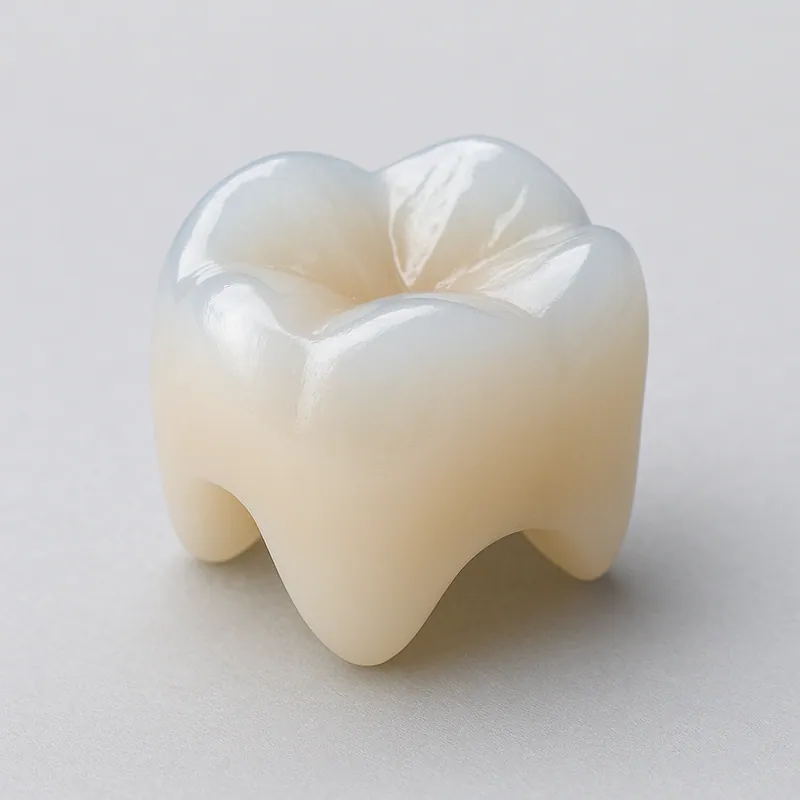
Cementation is the clinician's decision, but it starts shaping the restoration long before the seat appointment. How you plan to cement a crown affects how we design it, how we finish the intaglio and what we send back with it. Here is a general look at e.max and zirconia from the lab's side of the process.
Two broad approaches
Most crowns are seated with one of two general approaches.
- Adhesive bonding uses a resin cement system with surface treatment of both the restoration and the tooth. It relies on a micromechanical and chemical bond.
- Conventional or resin-modified cementation relies mainly on the retention and resistance form of the preparation, with the cement filling the space and sealing the margin.
Which one fits a case depends on the material, the preparation, moisture control and the clinician's judgment.
E.max and adhesive bonding
Lithium disilicate is a glass ceramic. It is commonly bonded, and bonding is often part of what gives a thinner e.max restoration its strength and esthetics in service.
Because it is translucent, the cement shade and the stump shade can both influence the final appearance. That is one reason we ask for the stump shade on e.max cases.
Some e.max crowns with adequate preparation geometry may be cemented conventionally, where the manufacturer's instructions allow it. That choice belongs to the treating dentist. For a closer look at material selection, see our post on zirconia vs. e.max crowns.
Zirconia and cementation
Zirconia is a polycrystalline ceramic, not a glass ceramic. It does not respond to the same surface treatments as e.max, and it is more forgiving of conventional or resin-modified cementation when the preparation provides good retention.
When retention is limited, such as a short clinical crown, many clinicians choose a resin cement system designed for zirconia. Surface preparation for zirconia is different from e.max, and it is important not to apply one material's protocol to the other.
Surface treatment follows the IFU
Surface treatment is where materials differ most, and it is where the manufacturer's instructions for use matter most. The restorative material, the cement system and any primers or conditioners each come with their own steps.
We recommend:
- Following the instructions for the specific material and cement system you are using
- Confirming whether any treatment has already been done at the lab, and what it was
- Keeping the intaglio clean after try-in, since saliva and other contaminants can interfere with bonding
If you are unsure what we did to the intaglio on a case, call us. We will tell you.
Try-in considerations
Try-in is the time to check fit, contacts, margins and esthetics before anything is permanent.
- Check fit and margins first, then contacts, then occlusion.
- For e.max, try-in pastes matched to the cement shades can help preview the final color.
- Make occlusal adjustments carefully, and follow the manufacturer's guidance on polishing or reglazing adjusted areas.
- Clean the restoration according to the material's instructions after try-in and before cementation.
Why we ask how you plan to cement
When our prescription form asks about cementation, it is not a formality. Your plan can influence:
- The cement space we design into the restoration
- How we finish and treat the intaglio surface
- Whether a more opaque or more translucent option suits the case
- Whether we flag a preparation that may need more retention for conventional cementation
The more we know, the better we can design for the way the crown will be seated. Learn more about our e.max crowns and zirconia crowns and bridges.
A quick conversation helps
If you are weighing bonding against conventional cementation on a particular case, we are happy to talk through what we see on the model or scan. Call us at 781.853.0777 or submit a case online.
Questions about a case?
Our technicians are glad to talk through materials, shade or design before you send it. Call 781.853.0777 or email ron@dentalcreations.net.
Send a case