
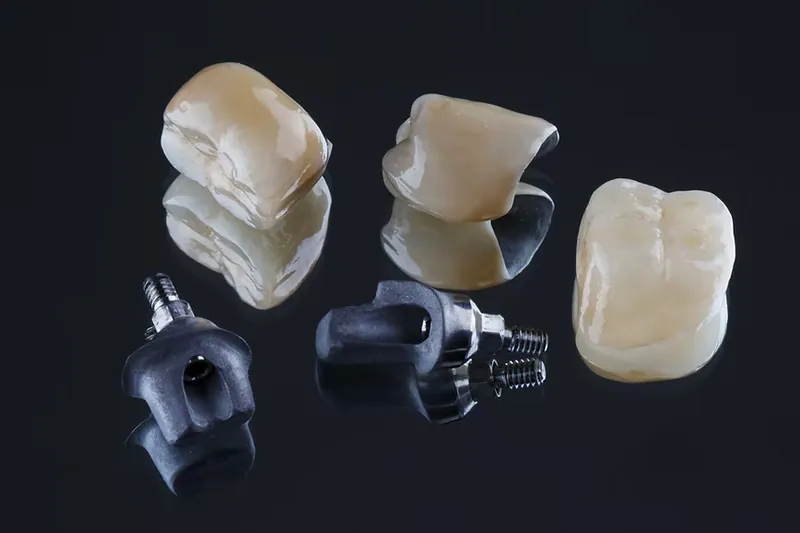
All-ceramic materials now cover most of the crowns we make, but porcelain-fused-to-metal has not disappeared from our bench. PFM has a long clinical track record, and for certain cases it remains the restoration a dentist prefers. Here is how we see its role today and what helps us make a PFM case well.
Why some dentists still prescribe PFM
PFM combines a cast metal substructure with layered porcelain. The metal provides support and a precise marginal fit, and the porcelain provides the esthetics. Dentists who still prescribe it often point to a few reasons:
- Familiarity and history. Many clinicians have decades of experience with PFM and know how it behaves in their hands.
- Matching existing work. A patient with several PFM crowns may be better served by a new restoration that behaves the same way optically.
- Splinted and long-span work. Some dentists prefer a metal framework for certain bridges and splinted units.
- Attachments and partial dentures. Restorations that need rest seats, milled surfaces or precision attachments are sometimes better suited to a metal framework.
- Patient or insurance preference. Some patients request it, and coverage can play a role in the plan.
The decision belongs to the treating dentist. Our part is to make the restoration well, whatever material is chosen.
Alloy categories in general terms
Dental alloys for PFM are commonly grouped by their noble metal content.
High noble
High noble alloys contain the highest proportion of gold and other noble metals. They are generally valued for corrosion resistance, workability and biocompatibility. They also tend to be the most expensive option.
Noble
Noble alloys contain a lower but still meaningful noble metal content, often with palladium or silver. They offer a middle ground in cost and properties.
Base metal
Base metal alloys, such as nickel-chromium or cobalt-chromium, contain little or no noble metal. They are rigid and economical. Some patients have sensitivities to certain base metal components, so the dentist's medical history review matters here.
The exact composition varies by manufacturer. If a patient has a known allergy or sensitivity, note it on the Rx and we can discuss alloy options with you.
Esthetic trade-offs at the margin
The metal substructure is the main esthetic limitation of PFM. It needs an opaque layer to mask it, and that layer can make the restoration look less lifelike than a translucent all-ceramic crown. The most visible area is usually the gingival margin, where a thin band of metal or a gray shadow can show, especially with gingival recession or a thin tissue biotype.
There are ways to reduce this. A porcelain butt margin, sometimes called a porcelain shoulder, removes metal from the facial margin. A metal collar on the lingual keeps strength where it is less visible. Preparation design needs to support whichever margin you choose. For high-esthetic anterior cases, many dentists choose e.max crowns or zirconia instead.
What to put on the Rx
A clear prescription helps us avoid assumptions on a PFM case:
- Alloy type. High noble, noble or base metal, plus any specific alloy you prefer.
- Margin design. Metal collar, porcelain butt margin, or a combination, and where each applies.
- Occlusal surface. Full porcelain coverage or metal occlusal, especially where clearance is limited or opposing teeth are natural.
- Shade and stump shade. Include characterization notes and photos.
- Pontic design and connectors for bridges.
- Known allergies or sensitivities.
Our dental lab prescription form has fields for each of these. You can learn more about our PFM crowns and custom abutments.
Planning a PFM case
If you would like to talk through alloy or margin options, call us at 781.853.0777, or submit a case online.
Questions about a case?
Our technicians are glad to talk through materials, shade or design before you send it. Call 781.853.0777 or email ron@dentalcreations.net.
Send a case