
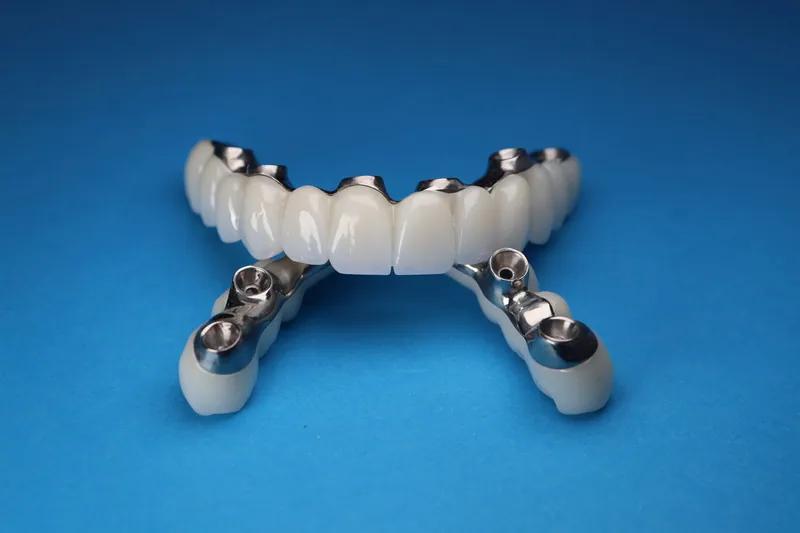
An abutment connects the implant to the crown, and it does more work than its size suggests. It shapes the tissue, sets the margin and determines the path of insertion. Stock abutments handle many cases well. Custom abutments handle the cases where a standard shape does not fit the patient. Here is how we think about the difference.
Stock and custom, side by side
A stock abutment is a prefabricated part made by the implant manufacturer in a set range of heights, diameters and angles. It is predictable and often economical.
A custom abutment is designed and milled for one implant site. We shape it from the scan or model so the profile, margin and axis match that patient's anatomy and the planned crown.
The question is not which one is better in general. It is whether a stock shape fits this site well enough.
Emergence profile
The emergence profile is how the restoration transitions from the implant platform through the tissue to the crown. Natural teeth do not emerge as round cylinders, and the tissue around an implant follows the shape it is given.
A custom abutment lets us shape that transition to support the tissue and match the adjacent teeth. In the esthetic zone, that can make the difference between a crown that looks placed and one that looks like it grew there. Where you have developed the tissue with a provisional, a custom abutment can carry that contour forward.
Margin placement
Stock abutments come with a fixed margin height that is the same all the way around. Tissue rarely is. The result can be a margin that is too deep on one side and too shallow on the other.
A custom abutment lets us follow the tissue contour, keeping the margin where it serves the esthetics and where you can reach it. That matters most for cement-retained crowns.
Angulation correction
Implants are not always placed in the ideal restorative axis. Bone volume and anatomy often decide the position. A custom abutment can correct the path of insertion so the crown seats along the right axis and sits in line with the arch, within the limits set by the implant manufacturer.
Cement cleanup
With a cement-retained crown, excess cement below the margin is a known risk for the tissue around the implant. A deep margin on a stock abutment makes that cement harder to see and harder to remove.
Because a custom abutment can place the margin at a reachable level, cleanup is more predictable. If you prefer to avoid cement altogether, a screw-retained design may suit the case.
When a custom abutment is worth it
A custom abutment is often the better choice when you see:
- Anterior implants in the smile line
- Uneven or scalloped tissue around the site
- An implant angled off the ideal restorative axis
- Deep tissue where a stock margin would sit too far down
- Wide or unusual tooth shapes that a stock profile does not support
- A tissue contour you have shaped with a provisional
For a straightforward posterior case with good position and even tissue, a stock abutment may serve well.
What to send
To design a custom abutment, we need:
- The implant manufacturer, system and platform
- A scan with the correct scan body, or an implant-level impression
- A scan or impression of the tissue, including any contour from the provisional
- The opposing arch and a bite record
- The planned crown material and shade
- Notes on margin preference and whether the crown will be cemented or screw-retained
We accept scans from any intraoral scanner. Our guide to sending digital scans to a dental lab covers what to include.
Learn more about our PFM crowns and custom abutments. If you have a site that a stock part will not fit, call us at 781.853.0777 or submit a case online.
Questions about a case?
Our technicians are glad to talk through materials, shade or design before you send it. Call 781.853.0777 or email ron@dentalcreations.net.
Send a case