
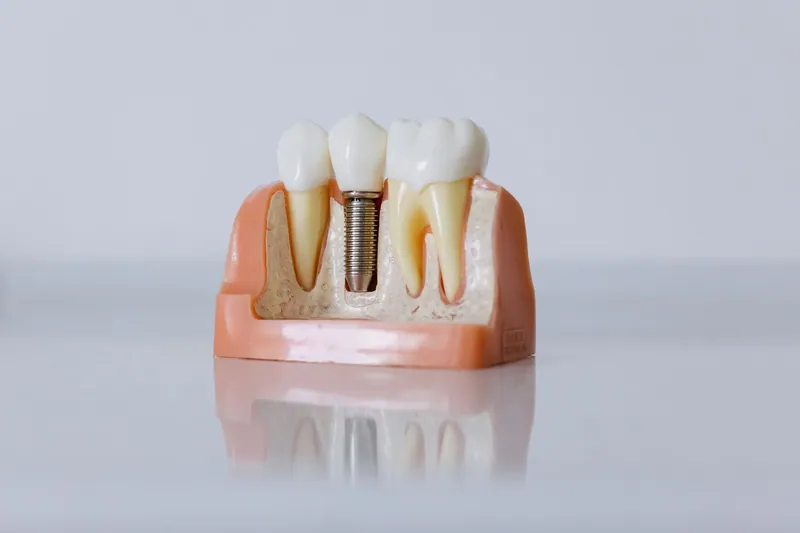
Every single-unit implant case raises the same early question: screw-retained or cement-retained. Both designs work well when they are planned for the situation in front of you. Here is how we weigh the trade-offs at the bench, and what we need from you to build either one.
The short version
- Screw-retained when retrievability matters, when you want to avoid cement near the tissue, and when the implant position puts the access hole somewhere acceptable.
- Cement-retained when the access hole would land in a visible or functional spot, when angulation needs correcting, and when you want an uninterrupted occlusal or facial surface.
Most of the decision comes down to implant position and how much the case may need to come back out.
Retrievability
A screw-retained crown can be removed without damaging it. That makes it simpler to address a loose screw, check the tissue, repair porcelain or adjust contacts later. For patients with a complex history, or for cases where future treatment is likely, that access is valuable.
A cement-retained crown can sometimes be retrieved, but it is less predictable. Depending on the cement, removal can mean cutting the crown off. If retrieval is part of your long-term plan, it points toward screw retention.
Excess cement
Residual cement around an implant is a well-recognized concern for peri-implant tissue health. Implants do not have the same soft tissue attachment as natural teeth, and cement pushed below a deep margin can be hard to see and hard to clean.
Screw retention removes that concern at the restoration level. If you prefer cement-retained, we can help by placing margins where you can reach them on a custom abutment rather than relying on a stock abutment with a fixed margin height.
Access hole position and esthetics
The access channel exits wherever the implant axis points. In the posterior, that is usually the central fossa, and the hole is filled after seating. In the anterior, a well-placed implant exits through the cingulum. A more facial implant can put the access hole through the incisal edge or facial surface, which is rarely acceptable.
Some implant systems offer angled screw channels that can move the access hole within limits set by the manufacturer. When that is not an option, a cement-retained crown on a custom abutment is usually the cleaner answer.
Angulation and interocclusal space
Angulation and vertical space both affect the choice.
- Angulation. A custom abutment can correct the path of insertion for a cemented crown. Screw retention depends more directly on the implant axis.
- Limited vertical space. A cemented crown needs enough abutment height for retention. When space is short, screw retention often works better because it does not rely on cement retention.
- Generous space. Either design is usually workable, and the choice can rest on retrievability and esthetics.
If you are not sure how a case will lay out, send the scan and ask. We can look at the implant position before you commit.
What to put on the Rx
Implant cases depend on accurate component information. Please include:
- The implant manufacturer, system and platform or connection size
- The scan body make and type, or the impression coping used
- Screw-retained, cement-retained or "lab to advise"
- Restoration material and shade
- Any preference for a titanium base, a custom abutment or a specific screw
- Notes on tissue contour, contacts and occlusion
Follow the implant manufacturer's instructions for use for torque values and component compatibility. Our prescription form has fields for all of this, and a complete Rx keeps the case moving without a phone call.
How we can help
We build both screw-retained and cement-retained implant restorations, and every case is inspected before it leaves the lab. If you are weighing the options on a specific case, call us at 781.853.0777 or submit a case online.
Questions about a case?
Our technicians are glad to talk through materials, shade or design before you send it. Call 781.853.0777 or email ron@dentalcreations.net.
Send a case