
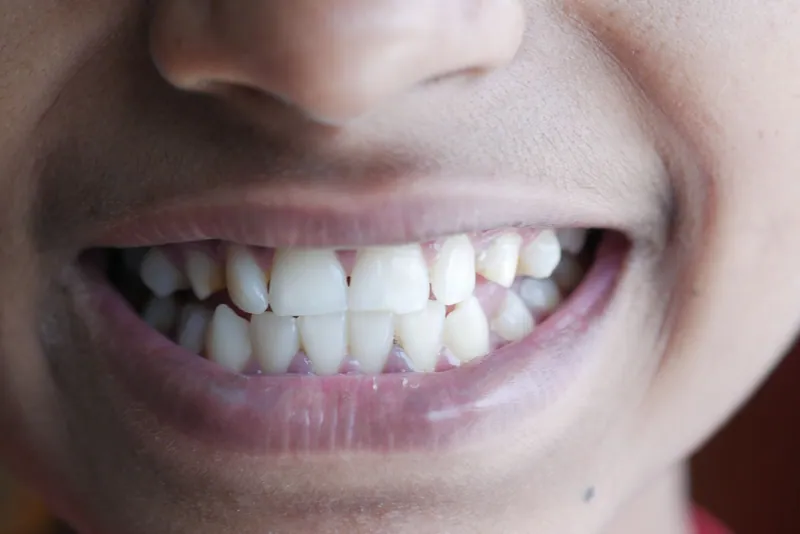
Ask any dental technician which case is the hardest, and most will give the same answer. A single central incisor next to a natural one. There is nowhere to hide. The patient, the dentist and everyone the patient talks to will compare the two teeth side by side. Getting it right takes good planning, good communication and some patience from everyone involved.
Why the single central is so difficult
Natural central incisors are not one color. They have a warmer, more opaque body near the gum line, more translucency at the incisal edge, and often subtle details such as craze lines, halos or white spots. Their surface texture and luster also change how light reflects.
When we restore two centrals together, we control both teeth and can make them match each other. With a single central, we have to match a tooth we did not make, with all of its individual character. Small differences in value, translucency or texture that would go unnoticed elsewhere in the mouth stand out at the midline.
Material considerations
Material choice depends on the case and is the treating dentist's decision. A few general points guide our recommendations.
E.max
Lithium disilicate is a common choice for a single anterior crown because it handles light much like natural enamel. It can be made monolithic and stained, or cut back and layered with porcelain for more depth and character. It is usually bonded. Learn more about our e.max crowns.
Layered options
For a central with a lot of internal character, a layered restoration gives the technician more control over translucency and effects at the incisal edge. Layering can be done over an e.max or zirconia substructure, depending on the space available and the stump shade.
When the stump is dark
A dark or discolored preparation, a metal post or a darker core can show through a more translucent material. In those cases, a more opaque substructure, such as zirconia layered with porcelain, may be a better path. This is a good conversation to have with us before you prepare. Our post on zirconia vs. e.max crowns covers the trade-offs in more detail.
Stump shade and photos
Because the preparation color affects the final result, the stump shade is one of the most useful pieces of information you can send. Take a shade of the prepared tooth and include it on the Rx.
Photos matter just as much. For a single central, we suggest:
- A retracted front view including the adjacent central and laterals
- Close-ups with shade tabs held in the same plane as the teeth, edge to edge
- A photo of the stump with a stump shade tab
- Photos in natural light where possible, without heavy flash glare
Several tabs in one photo, including one slightly lighter and one slightly darker than your choice, help us judge value more accurately.
Shade appointments
For many single centrals, an in-person shade appointment is the most reliable step. Ron Salvatore provides custom shading consultations at our Revere lab or in your office. Seeing the patient's tooth directly, in person, gives us information that photos cannot fully capture.
Plan for a try-in
We often recommend a try-in for a single central before final glaze or cementation. A try-in lets you and the patient look at the crown in the mouth, in natural light, next to the adjacent tooth. If the value, translucency or surface texture needs adjusting, we can refine it before it is final. Plan the schedule with this extra step in mind.
Setting realistic expectations
It helps to talk with the patient early about what to expect. A very close match is achievable, but no restoration is identical to a natural tooth in every lighting condition. Adjacent teeth may also change over time. Patients who understand the process, and know a try-in may be part of it, are usually more comfortable when an adjustment is needed.
Talk to us before you prep
If you have a single central coming up, a short call before the preparation appointment is time well spent. Call us at 781.853.0777 or submit a case online.
Questions about a case?
Our technicians are glad to talk through materials, shade or design before you send it. Call 781.853.0777 or email ron@dentalcreations.net.
Send a case