
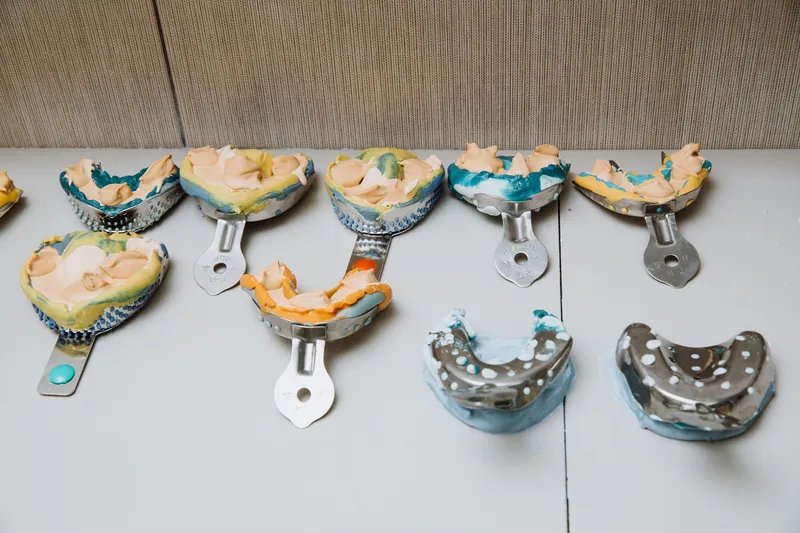
We receive both digital scans and conventional impressions every day, and we see good and difficult cases come in both ways. Neither method is right for every situation. Here is how the two compare from where we sit, and what helps us get the best result from each.
Where digital scans work well
Intraoral scans have become routine for single crowns and short bridges, and for good reason.
- Immediate feedback. You can see gaps, voids or a missed margin while the patient is still in the chair and rescan just that area.
- No distortion in transit. A scan does not shrink, tear or warp, and it does not depend on pour timing.
- Speed to the lab. The file arrives the moment you send it. We can start sooner and raise questions sooner.
- Easy records. Scans are simple to store, compare and resend.
For most single-unit crowns, onlays and veneers with accessible margins, a clean scan is an excellent starting point.
Where conventional impressions still work well
Conventional impressions remain a sound choice in a number of situations.
- When a practice does not have a scanner, or a particular operatory does not
- When a margin is deep and the material can be pushed into the sulcus after retraction
- When bleeding or saliva control is difficult, which can affect what the scanner records
- When the clinician has a well-established technique that produces consistent results
A well-taken impression with a properly selected material, handled and disinfected according to the manufacturer's instructions, still gives us everything we need.
Subgingival margins and retraction
This is where most margin questions start, regardless of method. Neither a scanner nor an impression material can record what it cannot reach or see.
With a scanner, the margin has to be visible to the camera. Blood, fluid or tissue over the margin will show up as a soft or missing edge. With an impression, the material has to flow into the space and release cleanly.
In both cases, retraction and hemostasis drive the result. If a margin is uncertain, we would rather you rescan or retake than send it hoping we can interpret it.
Full-arch and long-span cases
Scanners have improved for larger cases, but accuracy across a full arch or a long-span bridge depends on technique, scanning strategy and the system you use. Follow your scanner manufacturer's guidance for these cases.
Some clinicians still prefer conventional impressions or a verification step for long spans and full-arch work. We are glad to talk through a plan before you start.
Implant cases
Implant cases can be captured either way. Digitally, this means a scan body that matches the implant system and is fully seated. Conventionally, it means the correct impression copings and analogs for the system.
In both cases, tell us the implant system, platform and connection. That information shapes how we design implant restorations, whether screw-retained or cement-retained.
Patient comfort
Many patients find scanning more comfortable, especially those with a strong gag reflex. Others are fine with trays. A scan can also be easier to repeat for a small area than a full retake.
How we receive and use each
We accept scans from any intraoral scanner. You can send them to dentalcreationscad@gmail.com, and our digital dental lab page explains how we work with them. Conventional impressions can come to us through our pickup and delivery service throughout Greater Boston.
For practical tips on file setup and what to include, see our guide to sending digital scans to a dental lab.
If you have a case you are unsure how to capture, call us at 781.853.0777 or submit a case online.
Questions about a case?
Our technicians are glad to talk through materials, shade or design before you send it. Call 781.853.0777 or email ron@dentalcreations.net.
Send a case