
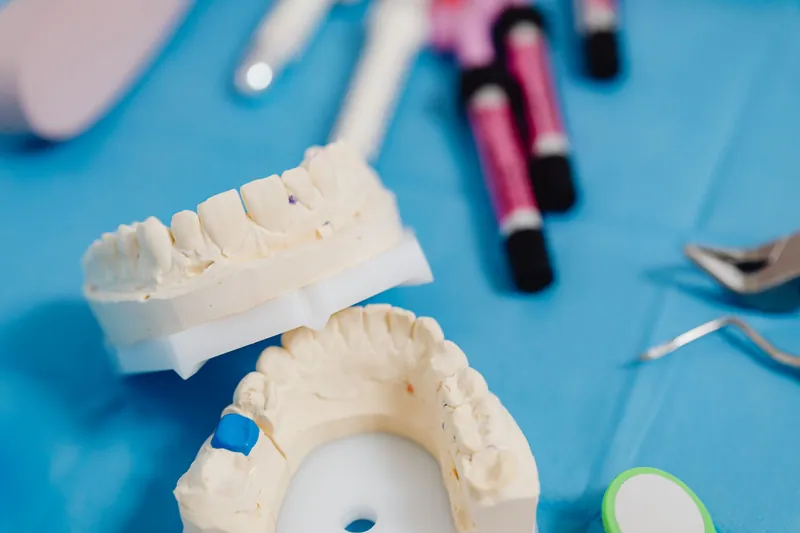
A crown can have perfect margins and still need a long adjustment if the bite record is off. At the bench, the bite is how we know where the opposing teeth will meet the restoration. When it is accurate, the crown usually seats with little or no occlusal adjustment. When it is not, we are guessing, and the chair time shows up on your end.
Why the bite record matters so much
We design occlusal anatomy, contacts and crown height to the relationship the bite record shows us. If the record holds the jaws slightly apart, we build a crown that is too short. If it pushes the teeth together or shifts them, the crown can come back high. Small errors in the record become visible errors at delivery.
Common bite record problems
Most of the bite issues we see fall into a few groups:
- Distortion. Material that is removed before it fully sets, or that is flexed or stored poorly, may not hold the relationship it captured. Follow the manufacturer's instructions for use for set time and handling.
- Overextension. A record that covers soft tissue, deep embrasures or the full facial surfaces can keep the models from seating into it. Trimming to the cusp tips usually gives us a cleaner fit.
- Incomplete seating. If the patient did not close fully into the material, the record shows an open bite. Watching the opposite side of the arch during closure helps confirm the patient is in their usual position.
- Mixing bites. Combining a bite from one appointment with a preparation from another, or sending two different records with no note on which to use, leaves us choosing between them.
- Drag or tears. Material pulled through undercuts or interproximal areas can tear and rebound, which changes the record in ways that are hard to see.
When in doubt, a short note on the Rx about anything unusual helps us read the record correctly.
Tips for digital bite capture
Digital bites remove some of these problems, but not all of them. A few habits help:
- Scan the bite on both sides. A buccal bite scan on each side of the arch gives the software a more stable relationship than a single side.
- Confirm the patient is in their usual closure. Coach the patient to close the way they normally do, and check that the bite looks the same as it does clinically.
- Avoid stitching errors. Make sure the buccal surfaces captured in the bite scan overlap clearly with the arch scans.
- Check the contacts on screen. Most scanner software shows occlusal contact maps. If the opposing teeth appear to pass through each other, or there is an obvious gap, rescan before sending.
If you are new to sending digital cases, our guide to sending digital scans to a dental lab covers file formats and what to include. We accept scans from any intraoral scanner.
When to send opposing and full-arch records
For a single posterior crown with stable occlusion on both sides, a quadrant scan or impression with an accurate opposing and bite is often enough. We recommend full-arch records when:
- You are restoring several teeth or the case spans both sides of the arch
- The patient has anterior guidance or excursive movements you want us to respect
- There is no stable stop on the opposite side
- You are making a bridge, multiple implants or an anterior case
Full-arch records let us see the whole occlusal scheme instead of a small window of it. That context helps us avoid building interferences we cannot see in a quadrant.
How the bite affects your adjustments
An accurate bite record does not remove the need to check occlusion at delivery. Clinical verification is always your call. What it does is narrow the adjustment to fine tuning instead of reshaping. Less grinding also means less risk of thinning the material or removing surface glaze and characterization that the patient sees.
If you have a preference for how heavy or light the occlusion should be, put it on the Rx. Our prescription form has space for occlusal and contact notes, and consistent preferences help us build crowns that seat the way you expect every time.
Questions about a case
If a bite record looks questionable, we will call before we design rather than guess. Call us at 781.853.0777 or submit a case online.
Questions about a case?
Our technicians are glad to talk through materials, shade or design before you send it. Call 781.853.0777 or email ron@dentalcreations.net.
Send a case